Face Tattoos: Best Ideas, Placements, Pain & Aftercare Guide

Face tattoos have moved far beyond the extreme, full-coverage styles that once dominated public perception. Today, many people choose subtle symbols, fine-line scripts, micro-florals and carefully placed blackwork that complement the natural structure of the face rather than overpower it. At the same time, facial tattooing has much older roots, with tattoo traditions extending back thousands of years across different cultures.
Because facial skin is thin, highly visible and constantly exposed to movement and sunlight, this is one of the least forgiving areas to tattoo. Needle depth, line weight, placement and long-term ageing all require careful planning. At Creato Tattoo, 114 Bold Street in Liverpool City Centre, Saeid offers private consultations and custom facial designs for clients who understand the permanence and visibility of this type of tattoo.

Consideration | What to Know Before Getting a Face Tattoo |
Best styles | Fine-line symbols, micro-script, blackwork, dotwork and small geometric designs |
Common placements | Temple, hairline, eyebrow area, upper cheekbone, behind the ear and jawline |
Pain level | Often more sensitive over thin, bony and nerve-rich areas |
Ink choice | Black ink is commonly preferred for crisp, simple facial designs |
Healing | Requires gentle, lightweight aftercare and careful hygiene |
Sun exposure | Daily UV protection is important once fully healed |
Social impact | Visibility may affect some workplaces and professional environments |
Studio policy | 18+ only, valid photo ID required and consultation recommended |
Best Face Tattoo Ideas & Design Trends
The most successful face tattoos are usually designed around facial anatomy rather than treated like ordinary body tattoos. A design that works well on the arm may feel oversized or visually unbalanced beside the eye, temple or jaw.
Modern facial tattooing increasingly favours intentional placement, smaller designs and cleaner linework. The goal is often to create something that looks naturally connected to the face rather than simply filling available skin.
Minimalist & Symbolic Styles
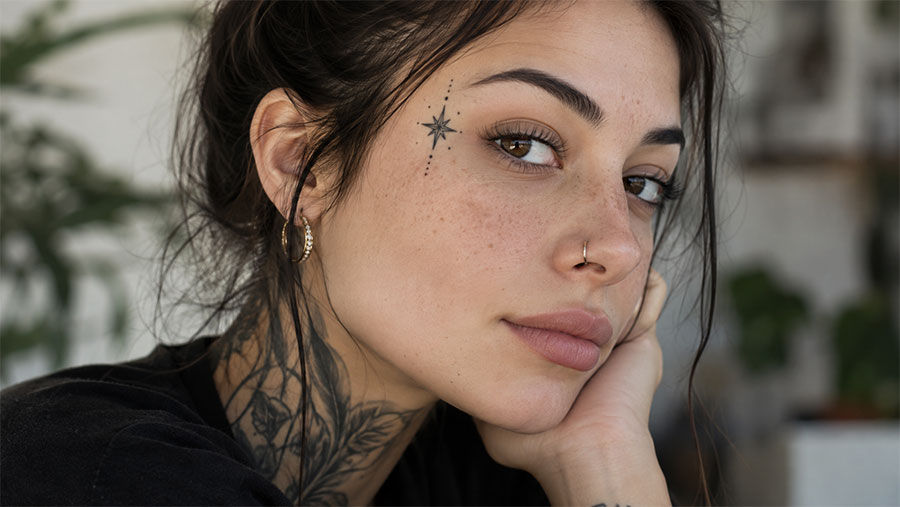
Fine-line and minimalist designs are popular with clients who want facial ink to remain relatively understated. Small botanical sprigs, micro-florals, tiny mandalas, stars, constellation-inspired patterns and simple symbolic shapes can work particularly well around the temple or outer eyebrow.
Other options include subtle beauty-mark dots, small hearts, infinity-inspired symbols and delicate cursive lettering. These styles depend heavily on precise spacing because even a tiny alignment problem becomes noticeable on the face.
Bold, High-Contrast & Blackwork Motifs
For a stronger visual statement, heavier blackwork can create a more graphic appearance. Gothic lettering, numbers, short words, arrows, crosses, daggers and skull-inspired motifs are commonly placed around the forehead, temple or jawline.
Larger designs may also transition from an existing neck or throat tattoo towards the face. This can create a more cohesive result than adding an isolated facial piece with no relationship to existing work.
Modern Artistic Styles
Contemporary face tattoos can also incorporate micro-realism, geometric patterns, dotwork, cybersigilism and Chicano-inspired lettering. These designs require careful scaling because extremely complex details may not remain as sharp as larger tattoos placed elsewhere on the body.
Black ink is often favoured for small facial tattoos because high-contrast linework can remain easier to read visually as the tattoo ages. Colour can still be considered, but design complexity, pigment choice, skin characteristics and long-term exposure should all be discussed with the artist beforehand.
Facial Placements: Mapping the Anatomy
Placement can completely change how a face tattoo feels. A small symbol at the hairline may look discreet, while the same design centred on the forehead can become the dominant feature of the face.
A good facial tattoo artist considers bone structure, facial expressions, hairlines, existing tattoos and natural asymmetry before applying a stencil.
The Temple & Hairline Border
The temple is one of the most versatile areas for subtle face tattoos. Designs can follow the natural border of the hairline, sit beside the eye or connect visually with sideburns and existing head or neck tattoos.
This location is particularly suited to small symbols, short scripts, geometric shapes and fine-line work because the design can frame the face without sitting directly in the centre of it.
Above the Eyebrow & Forehead Arch
Lettering and fine-line symbols above the eyebrow need to be positioned around the natural movement of the forehead. Raising the eyebrows, frowning and changing facial expressions can alter how straight lines and text appear.
For this reason, stencil testing is especially important. The design should be checked while the face is relaxed and while natural expressions are made before tattooing begins.
High Cheekbone & Orbital Under-Eye
Small symbols and dotwork near the upper cheekbone can create a highly distinctive look without requiring a large design. However, the area sits directly over prominent facial structures and close to sensitive tissue.
Simple designs generally suit these locations better than heavily detailed artwork. Careful placement can also help the tattoo follow the natural angle of the cheekbone rather than appearing visually disconnected.
Behind the Ear, Jawline & Neck Extensions
The area behind the ear and along the jaw can offer a softer transition into facial tattooing. These placements are still visible but may be easier to integrate with hairstyles, sideburns or existing neck tattoos.
They are particularly useful when extending an established tattoo composition upwards rather than starting with a highly central facial placement.
The Cultural Evolution & Meaning Behind Face Ink
Facial tattooing is not a modern invention. Different Indigenous and traditional communities have practised forms of facial marking for thousands of years, using them to communicate identity, ancestry, social position, life events and cultural belonging.
Māori tā moko is one important example of a living cultural tradition rather than simply a modern tattoo style. Traditional cultural markings should therefore be understood within their own cultural context rather than copied casually as decorative motifs.
From Ancient Roots to Modern Fashion
In contemporary Western culture, face tattoos have become increasingly visible through musicians, artists, athletes and other public figures. Celebrities including Justin Bieber, Kehlani, Drake and Amber Rose have contributed to wider exposure to small facial tattoos and statement pieces.
This visibility has helped move public perception away from the idea that every facial tattoo must involve extensive coverage. Fine-line symbols, micro-lettering and smaller placements now represent a significant part of modern facial tattoo aesthetics.
Personal Sovereignty & Self-Expression
For many clients, choosing a facial tattoo is a particularly strong form of personal expression because it cannot be hidden as easily as a tattoo on the torso, leg or upper arm.
That visibility can make the design feel especially meaningful, but it also makes impulsive choices more difficult to reverse. A consultation gives clients an opportunity to reconsider scale, meaning and placement before committing.
Technical Considerations: Skin, Pores & Ink Longevity
Facial skin behaves differently from many commonly tattooed areas of the body. It is frequently exposed to sunlight, naturally produces oils and contains areas where skin sits very close to bone.
These characteristics make controlled technique particularly important. Fine facial work leaves little room for excessive depth, inconsistent line weight or unnecessarily complicated details.
Why Black Minimalist Designs Are Popular
Simple black designs tend to provide strong contrast without relying on multiple subtle pigment transitions. This can make them particularly suitable for micro-symbols, short scripts and other small facial tattoos.
The best choice still depends on the client's skin, design and intended result. The artist should assess whether the requested level of detail is realistic at the proposed size instead of shrinking an intricate design until it becomes difficult to execute or maintain.
Needle Depth & Blowout Risks Over Bone
Many facial areas have relatively little cushioning between the surface of the skin and the underlying structure. If ink is placed too deeply, it may spread outside the intended line and create a blurred appearance known as blowout.
Precise machine control and conservative linework are therefore essential. This is one reason facial tattoos should be approached as specialist work rather than treated as a quick version of a standard body tattoo.
Permanent Sun Exposure & UV Fading
Unlike a tattoo hidden beneath clothing, facial ink is exposed to daylight almost every day. UV exposure can contribute to fading and reduced contrast over time.
Once the tattoo is completely healed, regular broad-spectrum sun protection can help protect both the tattoo and surrounding skin. Fresh tattoos should instead follow the specific healing instructions provided by the artist and be protected from unnecessary sun exposure during recovery.
Social Realities, Pain & the “Job Stopper” Factor
The face remains one of the most socially visible tattoo placements. Acceptance has increased in many creative and customer-facing environments, but policies and attitudes differ significantly between employers and industries.
Anyone considering facial ink should therefore think about both personal expression and their likely professional circumstances. A facial tattoo should be chosen because the client is genuinely comfortable living with that visibility.
How Painful Are Face Tattoos?
Pain varies from person to person, but facial tattooing can feel intense because many placements involve thin skin, prominent bone and sensitive tissue. Areas around the temple, forehead and cheekbone may feel sharper than fleshier areas elsewhere on the body.
Small designs often keep sessions relatively short, which can make the experience easier to manage. Clients should discuss pain management with their artist rather than applying numbing products without checking whether they are appropriate for the planned procedure.
Workplace Perceptions & the Generation Gap
Face tattoos may still carry stronger social associations than tattoos on the arms, legs or torso. Some workplaces have relaxed their appearance policies, while others continue to restrict highly visible tattoos.
The practical impact therefore depends on occupation, employer and individual circumstances. For anyone uncertain about future career implications, a discreet placement or a tattoo that remains partly concealed by the hairline may be worth considering before choosing a central forehead or cheek design.
Ethical Standards, Policies & Booking at Creato Tattoo
Because of their permanence and visibility, face tattoos in Liverpool should begin with a serious consultation rather than an impulsive appointment. Creato Tattoo takes a cautious approach to facial work and may advise against the procedure when the client has little or no previous experience with tattoos.
The aim is not simply to complete the tattoo, but to make sure the client understands the long-term implications of the placement.
The “Coverage First” Ethical Philosophy
Reputable tattoo artists may be reluctant to place highly visible facial tattoos on clients who have little existing body coverage. Previous tattoo experience gives a person a better understanding of healing, permanence and how their relationship with body art may change over time.
This approach also creates space for an honest conversation about whether a face tattoo is genuinely the right next step.
Digital Stencils & Placement Visualisation
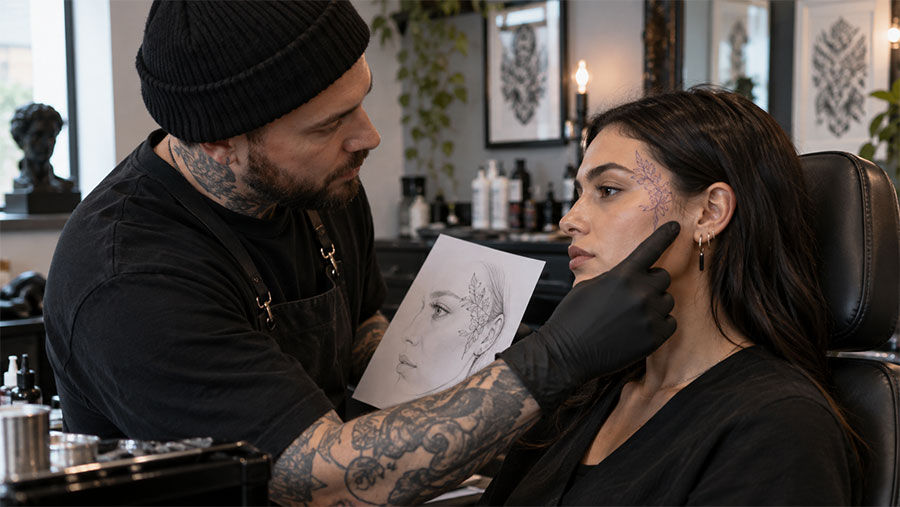
A few millimetres can significantly change the appearance of a small facial tattoo. Temporary stencils allow the artist and client to test different sizes, angles and positions before any ink is placed.
For lettering, the process is particularly useful for checking font scale, spacing and how the design responds to natural movement around the eyes, eyebrows and forehead.
Studio Policy & Deposit Protocol
Creato Tattoo provides tattooing services only to clients aged 18 or over, with valid government-issued photographic identification such as a passport or driving licence. Appointments may require an advance, non-refundable deposit to reserve studio time and cover preparation of custom artwork.
Clients who arrive under the influence of alcohol or recreational drugs will not be tattooed. The studio brief also advises against tattooing clients who have recently taken blood-thinning medication. Prescribed medication should never be stopped simply to qualify for a tattoo appointment; discuss your circumstances with the studio and, where appropriate, the healthcare professional who prescribed it.
Hygiene at the Bold Street Studio
Facial tattooing requires particularly careful hygiene because the working area is close to the eyes, mouth, hair and other areas that are frequently touched.
Creato Tattoo uses single-use disposable cartridges, protective barrier materials and professional tattoo inks, alongside sterile working procedures designed to reduce contamination risk throughout the appointment.
Facial Tattoo Healing & Aftercare
Facial tattoos need gentle aftercare. The skin naturally produces oil, comes into regular contact with pillows, hair and hands, and may be exposed to skincare or cosmetic products that are unsuitable for a fresh tattoo.
Follow the artist's specific aftercare instructions and avoid overloading the area with thick products. Lightweight, fragrance-free and non-comedogenic products may be recommended when moisturising is appropriate.
Managing Natural Oils & Healing
A fresh facial tattoo should be kept clean without excessive washing or scrubbing. Picking flakes, repeatedly touching the tattoo or applying multiple skincare products can interfere with normal healing.
Make-up, strong active skincare ingredients and unnecessary friction around the tattoo should also be avoided until the area has progressed sufficiently through healing according to the artist's instructions.
Touch-Ups & Natural Micro-Fallout
Very fine tattoos can sometimes heal with small areas appearing lighter than others. This does not automatically mean the tattoo was applied incorrectly; individual healing, placement and extremely delicate linework can all influence the result.
The healed tattoo should be assessed only after the initial recovery period. Where necessary, a small adjustment session can restore individual lines or details once the skin is ready to be tattooed again.
FAQ About Face Tattoos in Liverpool
How painful are face tattoos compared with body tattoos?
They can feel sharper than tattoos on fleshier areas because many facial placements sit over thin skin and prominent bone. Pain still varies significantly by individual and placement.
Why do artists often recommend black ink for the face?
Black ink provides strong contrast and works well for the small, simplified designs commonly used on the face. It is especially popular for fine-line symbols, lettering and minimal blackwork.
Will having a face tattoo affect employment in Liverpool or the UK?
It can. Workplace policies vary considerably, and some employers remain more restrictive about facial tattoos than tattoos that can be covered with clothing. Consider your current and future working environment before choosing the placement.
Does Creato Tattoo tattoo clients who have no previous tattoos?
The studio takes a cautious, ethical approach to facial tattooing and may recommend gaining experience with less visible tattoo placements first. Individual cases can be discussed during consultation.
Book a Face Tattoo Consultation in Liverpool
Face tattoos require more planning, technical precision and personal certainty than almost any other tattoo placement. The right design should work with your facial structure, remain readable at a realistic scale and suit the level of visibility you are comfortable living with long term.
If you are considering a fine-line symbol, micro-script, blackwork piece or another custom facial design, speak with Saeid at Creato Tattoo, 114 Bold Street, Liverpool City Centre. Book a private consultation to discuss the concept, placement and practical realities before committing to permanent facial ink.


Comments