All About Realism Tattoos

Updated: Sep 20
A realism tattoo transforms skin into a living canvas, recreating the depth, emotion and fine detail of a photograph through carefully controlled light and shadow. Rather than depending on heavy outlines, the artist builds the image with smooth gradients, precise contrast and selectively sharpened details, allowing reflective eyes, textured fur, sculpted faces and delicate expressions to appear almost three-dimensional on the body.
At Creato Tattoo, realism is approached as a precision art form. From our studio at 114 Bold Street in Liverpool City Centre, we create custom black and grey and colour realism pieces shaped around the client’s reference, anatomy and long-term expectations. Every design is adapted to the body rather than copied directly from a screen, helping the finished tattoo retain its clarity, balance and visual impact as it heals.
Realism style | Best suited to | Visual character |
Black and grey realism | Portraits, memorial pieces, statues and Chicano designs | Timeless, dramatic and contrast-led |
Colour realism | Wildlife, flowers, film characters and nature scenes | Vibrant, dimensional and highly expressive |
Surreal realism | Dreamlike compositions and symbolic artwork | Imaginative, unusual and visually layered |
Black and Grey vs Colour Realism: Which Style Suits You?
Choosing between black and grey and colour realism is not simply a matter of personal taste. The best option depends on the subject, placement, desired mood, skin tone and how much visual contrast the design requires. Both styles can produce striking results, but they use different techniques to create depth and preserve important details.
During your consultation at our Bold Street studio, we assess the reference image, discuss your preferred aesthetic and explain how each approach may age on your chosen placement. This allows you to make a decision based on both appearance and long-term tattoo quality.
Black and Grey Realism: Timeless Contrast
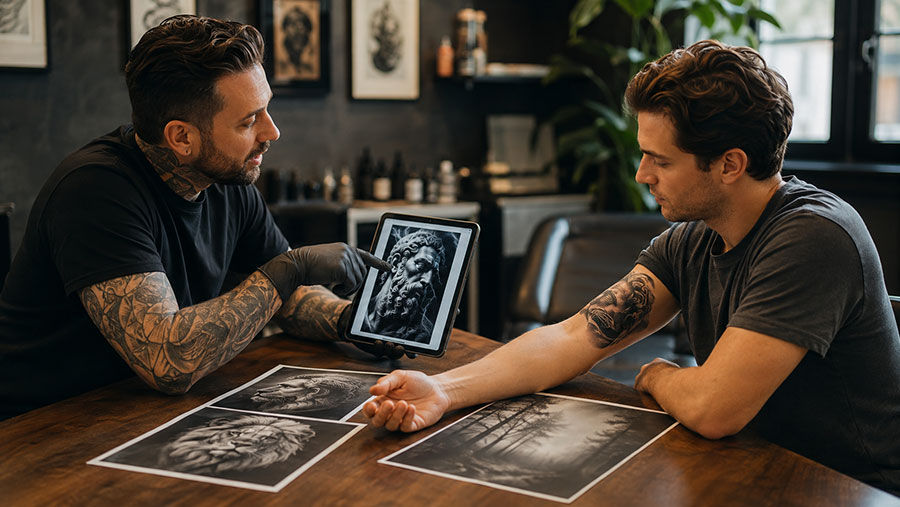
Black and grey realism uses pure black, diluted grey washes and untouched skin to create a full range of tones. Deep shadows give the design structure, while softer gradients produce skin texture, smoke, stone, fabric and facial contours. Negative space may also be used to simulate reflected light and prevent the design from becoming visually heavy.
This approach is especially effective for portraits, memorial tattoos, religious imagery, statues and Chicano-inspired compositions. Because the style relies on value and contrast rather than multiple pigments, it often has a classic, cinematic quality that works well across large sleeves, chest pieces and detailed standalone designs.
Colour Realism: Vivid Lifelike Art
Colour realism recreates the temperature and saturation found in the original subject. Warm and cool tones are layered carefully to reproduce skin, feathers, scales, flowers, metal, fire, water and natural light. Successful colour realism requires more than choosing accurate pigments; the artist must understand how colours interact with each other and with the client’s natural skin tone.
This style is particularly suited to wildlife, botanical subjects, cinematic characters, fantasy artwork and vivid pop-culture designs. Strategic black values are still essential because they provide the framework that keeps brighter colours readable once the tattoo has healed.
Popular Realism Tattoo Motifs and Portraiture Artistry
Realism can be used to reproduce almost any subject, but some concepts benefit especially strongly from its ability to show emotion, material and depth. The complexity of the final tattoo depends on the clarity of the reference, the available space and the number of textures that must be recreated.
Our artists develop each composition as a custom piece. Even when the design begins with an existing photograph, its proportions, shadows and focal points are adjusted to suit the natural movement of the body.
Portraits and Memorial Art
Portrait tattoos are among the most demanding forms of realism. A small difference in eye spacing, mouth shape or facial angle can affect whether the subject feels recognisable. Accurate proportion mapping is therefore essential, especially when recreating a loved one, public figure, musician, actor or historic personality.
For memorial tattoos, we also consider the emotional character of the reference. Sometimes the clearest image is not necessarily the most meaningful one. Where possible, we help clients compare photographs and select a reference that offers both personal value and enough lighting information for a successful tattoo.
Animal and Wildlife Realism
Wildlife realism depends on texture. Fur must follow the direction of the animal’s anatomy, feathers require layered edges, scales need consistent patterning and eyes must contain enough reflection to feel alive. These effects are created through gradual shading and selective sharpness rather than by outlining every individual detail.
Lions, wolves, tigers, birds, snakes and pets are popular choices, but the composition should always reflect the available space. A detailed animal face generally requires sufficient scale to preserve the eyes, nose, fur transitions and surrounding shadows.
Statues and Classical Sculptures
Classical sculptures and Greek or roman tattoo statue designs are naturally suited to black and grey realism because their form is already defined by light and architectural shadow. Smooth grey gradients can imitate marble, while deep blacks add cracks, recesses and dramatic depth.
Classical subjects can also be combined with clocks, columns, flowers, geometric elements or symbolic lettering. The strongest designs maintain a clear visual hierarchy so the face or sculpture remains the main focal point rather than becoming lost among supporting details.
Surreal and Chicano Realism
Surreal realism and dark horror tattoos combine recognisable subjects with impossible or dreamlike elements. Faces may dissolve into landscapes, statues may merge with animals and realistic objects can be arranged in symbolic compositions. This gives the client more creative freedom while retaining the technical depth of realism.
Chicano realism often uses black and grey portraiture, religious references, lettering, lowrider culture, roses, masks and urban symbolism. Smooth tonal transitions and strong contrast help connect these elements into one cohesive narrative.
The Anatomy of a Long-Lasting Realism Tattoo
One of the most common concerns about realism tattoos is whether the fine shading will eventually blend into an unclear image. Aging is affected by several factors, including design scale, contrast, placement, sun exposure, aftercare and the way the tattoo was applied.
A long-lasting realism tattoo is not simply packed with as much detail as possible. It is designed with enough separation between dark, mid-tone and light areas to remain readable after the skin has healed and naturally changed over time.
Factor | Main Principle | Design Focus | Long-Term Benefit |
Contrast | Balance dark, mid-tone and light values | Use strategic black, shadows and highlights | Keeps the tattoo readable and preserves depth |
Needle Precision & Skin Control | Detail depends on technique, not needle size alone | Control pressure, hand speed, skin tension and layering | Reduces overworking, scarring and pigment spreading |
Scale | Complex details need enough space | Give eyes, hair, teeth and facial shadows room to remain distinct | Improves clarity as the tattoo ages |
Contrast Is King
Soft grey washes create smooth realism, but they need dark values for support. Strategic areas of solid black give the piece structure and prevent lighter shading from appearing flat. This does not mean every tattoo needs to look overly dark; it means the shadows must be strong enough to preserve depth.
The same principle applies to colour realism. Rich colours remain more effective when they are supported by carefully placed dark tones and clear highlights. Without this framework, detailed areas may lose separation as pigments settle.
Needle Precision and Skin Control
Realism artists may use fine needle configurations for small textures, facial features and sharp focal points. However, precision is not achieved through needle size alone. Machine control, hand speed, skin tension, pressure and experience all influence whether the pigment enters the skin evenly.
The goal is to build detail without repeatedly overworking the same area. Excessive trauma can affect healing and increase the risk of texture, scarring or pigment spreading. Controlled layering allows the artist to create smooth gradients while respecting the skin.
Scale Determines Clarity
A complex portrait cannot always be reduced to a very small size without sacrificing accuracy. Eyes, teeth, jewellery, hair and subtle facial shadows need enough space to remain separate. When too much information is compressed into a small area, the tattoo may initially appear detailed but become harder to read as it ages.
Choosing a larger format gives the artist room to simplify less important areas while sharpening the main focal points. This creates a more convincing image and usually offers better long-term clarity.

Crafting Your Custom Realism Piece at Creato Tattoo Liverpool
The process begins with your idea and reference material. Clients can visit our Liverpool City Centre studio or send images via WhatsApp for an initial feasibility review. We assess whether the photograph contains enough resolution, contrast and visible detail to guide the design.
From there, the reference is transformed into a bespoke composition that fits the chosen placement. Scale, cropping, contrast and surrounding elements may all be adjusted to support both the artistic result and the natural flow of the body.
Selecting High-Resolution References
The strongest realism references have a clear focal point, sharp details and a visible light source. Side lighting or directional lighting is often more useful than a flat image because it reveals facial structure, texture and depth.
Screenshots, compressed social-media images and heavily filtered photographs may contain less usable information. When the ideal image is unavailable, our artists can advise whether multiple photos can be combined or whether certain areas need to be simplified.
Bespoke Digital Mockups
Before tattooing begins, the subject is adapted digitally to suit the body. A portrait designed for an outer arm requires different proportions from one intended for a thigh or chest. The composition must account for muscle movement, curvature and the angle from which the tattoo will usually be viewed.
Digital preparation also allows the artist to strengthen shadows, remove distracting backgrounds and establish the visual hierarchy of the piece. The final tattoo remains custom rather than becoming a direct print of the original photograph.
A Calm, Professional Studio Standard
Realism sessions require concentration, preparation and patience. Our Bold Street studio provides a calm environment where the artist can focus on fine shading, accurate stencil placement and consistent detail.
Hygiene procedures, single-use equipment where required and professional studio practices are followed throughout the appointment. Ink selection and application techniques are chosen with healed clarity, skin safety and long-term quality in mind.
Ideal Placements for Large-Scale Realism
Realism performs best on placements that provide enough uninterrupted space for gradients and important details. While smaller pieces are possible, complex portraits, wildlife scenes and multi-subject compositions usually benefit from a larger canvas.
Your artist will consider both the flat working area and how the tattoo appears when the body moves. The best placement is one that supports the design rather than forcing the subject into an unsuitable shape.
Outer Arm and Full Sleeves
The outer upper arm offers a relatively smooth surface for portraiture and animal faces. It can also become the starting point for a full realism sleeve, with supporting elements flowing around the inner arm and forearm.
Sleeves allow multiple subjects to be connected through smoke, architecture, clouds, rose tattoo elements, fabric or abstract shading. Planning the full concept early helps avoid awkward gaps and ensures each section contributes to one continuous composition.
Thighs and Calves
The thigh provides a wide canvas for statues, animals, cinematic characters and detailed scenes. Its scale makes it possible to retain small textures without overcrowding the design.
Calves are well suited to tall compositions and portrait-focused pieces. Because the muscle has a natural curve, the image must be positioned carefully to remain balanced from the front and side.
Back and Chest Pieces
The back offers the largest continuous canvas for complex realism. It can support multiple portraits, full wildlife scenes, large sculptures or narrative artwork with architectural depth.
Chest pieces create a powerful frontal composition but require careful planning around the sternum, collarbones and pectoral movement. Large back and chest projects are usually completed across multiple appointments to protect the skin and maintain consistent quality.
Realism Session Guide: What to Expect at Our Bold Street Studio
The duration of a realism tattoo depends on its scale, placement, level of detail and whether it is being completed in black and grey or colour. Small portrait-style pieces may require one long appointment, while sleeves, back pieces and complex compositions are normally divided into several sessions.
Spacing the work properly allows each area to heal before additional details or connecting sections are added. Your artist will explain the estimated session plan during the consultation.
1. Photo and Design Consultation
We begin by reviewing your reference images, placement ideas and preferred style. Clients can bring photographs to the studio or send them through WhatsApp before booking.
At this stage, we discuss the feasibility of the reference, recommended scale, estimated session time and any adjustments needed to improve the design.
2. Contrast and Stencil Preparation
The design is edited to strengthen important values and fit the selected body area. A precision stencil is then positioned while you are standing naturally so the artwork follows the muscle flow.
The artist may reposition the stencil more than once to ensure the central features sit correctly and remain visually balanced.
3. The Inking Process
Many realism pieces are built by establishing the darkest values first and gradually developing mid-tones, textures and lighter details. This gives the artist a stable contrast structure throughout the session.
White ink may be used selectively for reflected light or small highlights, but it is not intended to replace proper negative space and tonal planning.
4. Proactive Aftercare
Fine shading needs careful protection during the initial healing period. You will receive specific instructions on cleaning, moisturising and protecting the tattoo from friction.
During the first two weeks, avoid picking, scratching, soaking and exposing the area to direct sunlight. Once healed, regular sun protection helps maintain both colour and black and grey realism.

Realism Tattoo FAQs
How many hours or sessions does a realism tattoo sleeve take?
A full realism sleeve is normally completed over multiple sessions. The exact schedule depends on the number of subjects, background complexity, colour use and how much of the arm is being covered.
Rather than rushing the project, the sleeve may be divided into sections such as the upper arm, forearm and connecting background. A personalised estimate can be provided after the artist reviews your concept and arm size.
Can a blurry or low-quality photo be used for a realism tattoo?
A slightly imperfect image may still be useful, particularly when other photographs of the same subject are available. However, a severely blurred or compressed photo may not contain enough reliable information to reproduce facial features accurately.
An artist can improve contrast and simplify backgrounds, but missing details cannot always be recreated authentically. Send the original files via WhatsApp whenever possible rather than screenshots or images saved from social media.
Where is Creato Tattoo located in Liverpool?
Creato Tattoo is located at 114 Bold Street, Liverpool, L1 4HY, in Liverpool City Centre. The studio is conveniently positioned near Liverpool Central Station and is accessible from surrounding areas across Merseyside.
Clients can arrange a consultation at the studio or contact the team online to discuss references and appointment availability.
Does colour realism fade faster than black and grey?
Colour pigments can change more noticeably when they are exposed frequently to strong sunlight, particularly lighter and warmer shades. However, professionally applied colour realism can retain excellent definition when the design includes strong contrast and is cared for correctly.
Using high-SPF sun protection after healing, avoiding unnecessary UV exposure and following the artist’s aftercare guidance can significantly support colour longevity.
Turn Your Reference Photo into Masterpiece Ink
A convincing realism tattoo requires more than technical detail. It demands patience, proportion, controlled contrast and a clear understanding of how light behaves across both the subject and the human body. Every shadow must have a purpose, every highlight must support the focal point and every small detail must remain readable within the chosen scale.
Have a portrait, animal, statue or cinematic reference you want to bring to life? Visit Creato Tattoo at 114 Bold Street in Liverpool City Centre, or send your images to our team via WhatsApp for an initial feasibility check, consultation and custom quote.


Comments