Ultimate Guide to Blackwork Tattoos

Updated: Sep 18
Pure black ink has a visual power that few tattoo styles can match, transforming the skin through bold contrast, precise negative space and deep, consistent saturation. A blackwork tattoo is not limited to one aesthetic; it can range from fine-line ornamental patterns, dotwork and geometric tattoo elements to gothic illustration, dark art and large areas of solid black. At Creato Tattoo, every piece is designed around the client’s anatomy, personal style and long-term tattoo plans, with careful attention to crisp linework, smooth black packing and balanced composition. Located at 114 Bold Street, Liverpool L1 4HY, our Liverpool City Centre studio creates bespoke blackwork tattoos for clients seeking striking, timeless artwork executed with technical precision.
Blackwork style | Visual characteristics | Suitable placements |
Illustrative and dark art | Gothic imagery, surreal forms, fine details and heavy shadows | Forearm, upper arm, thigh and back |
Geometric and ornamental | Mandalas, symmetry, dotwork and repeated patterns | Chest, sternum, back, shoulders and sleeves |
Tribal and neo-tribal | Flowing lines, abstract shapes and bold body-contouring forms | Arms, legs, ribs and shoulders |
Heavy blackwork | Solid saturation, negative space and large areas of packed black | Sleeves, legs, chest and back |
Popular Blackwork Tattoo Styles and Design Concepts
The versatility of black ink allows artists to move between subtle detail and powerful visual impact. Some people choose blackwork because they prefer monochrome artwork, while others are drawn to its gothic, spiritual, geometric or alternative influences.
Understanding the main blackwork styles can help you identify the direction that best suits your body, personal aesthetic and existing tattoos.
Illustrative and Dark Art Blackwork
Illustrative blackwork combines drawing-based linework with different levels of solid black and textured shading. Designs may include animals, mythological figures, medieval imagery, skull tattoo designs, botanical subjects or surreal scenes.
Dark art blackwork often pushes this approach further through gothic symbolism, distorted figures and dramatic areas of shadow. The artist must carefully control the relationship between light and dark so important details remain visible rather than becoming lost inside heavy shading.
These designs are particularly effective on the forearms, upper arms, thighs and back, where the artist has enough space to build depth and create a clear focal point.
Geometric and Ornamental Blackwork
Geometric blackwork uses symmetry, repetition and precisely measured lines to create balanced compositions. Common elements include sacred geometry, mandalas, circular forms, architectural shapes and dotwork transitions.
Ornamental blackwork is often inspired by jewellery, decorative carving, lace, filigree and traditional pattern-making. These tattoos may follow the sternum, spine, shoulders, neck or natural curves of the arms and legs.
Small inconsistencies can become highly visible in a symmetrical design. Accurate stencil placement, steady linework and a clear understanding of anatomy are therefore essential, especially when creating a geometric or ornamental blackwork tattoo in Liverpool.
Tribal and Neo-Tribal Blackwork
Traditional tribal tattooing includes styles with specific cultural origins, techniques and meanings. Designs inspired directly by Polynesian, Māori or other Indigenous traditions should be approached with respect and an understanding of their cultural significance.
Neo-tribal blackwork uses bold flowing lines, sharp abstract shapes and large areas of negative space without necessarily copying a specific traditional system. These designs are often created to wrap around the body and emphasise the structure of the shoulders, arms, ribs or legs.
The strongest neo-tribal pieces are designed for the individual rather than copied from a flat reference image. Curves, points and black sections should move naturally with the body from every viewing angle.
Heavy Blackwork and Solid Saturation
Heavy blackwork uses fully saturated black areas to create maximum contrast. It can include solid bands, abstract forms, blackout tattoo sections or large graphic compositions broken up by areas of untouched skin.
Although the finished result may look simple from a distance, packing large areas of black requires significant technical control. The artist must distribute the ink evenly while avoiding excessive passes over the same area.
Poor technique may create inconsistent colour, visible patches, unnecessary swelling or damage that affects the final texture of the skin. At Creato Tattoo Liverpool, heavy black sections are built carefully with appropriate needle groupings, controlled pressure and close attention to how the skin responds throughout the session.
Blackwork as a Cover-Up Solution in Liverpool
Blackwork can be an effective option for covering an old, faded or unwanted tattoo because dense black sections can conceal colours and lines that would remain visible beneath lighter designs. However, a successful cover-up requires more than simply placing a dark shape over the existing tattoo.
The artist must assess the size, darkness, age and position of the original ink. The new composition usually needs to be larger than the old tattoo and strategically designed so the darkest sections sit over the areas requiring the most coverage.
Blackwork Topic | Main Concepts & Techniques | Key Considerations & Recommendations |
Blackwork as a Cover-Up | Dense black sections effectively conceal old, faded, or unwanted colors and lines. | Artists must assess the original ink's size, darkness, age, and position; new designs must be larger and strategically placed. |
Custom Cover-Ups & Preparation | Uses dark illustrative imagery, ornamental patterns, or abstract shapes with negative space to prevent a heavy look. | Very dark, raised, or scarred tattoos may need laser-lightening sessions first to give artists more creative freedom. |
Negative Space & Blast-Over | Negative space leaves untattooed skin for separation and readability; blast-over layers new blackwork over old ink while keeping parts visible. | Blast-overs create an experimental, distressed, or alternative aesthetic. Consultations at the Bold Street studio in Liverpool help determine the best approach. |
Custom Blackwork Cover-Ups
A personalised cover-up may use dark illustrative imagery, ornamental patterns or abstract shapes to disguise the original tattoo. Negative space can then be introduced around the darker areas to prevent the finished piece from appearing unnecessarily heavy.
Not every tattoo can be completely hidden without preparation. Very dark, raised or heavily scarred tattoos may benefit from one or more laser-lightening sessions before the new design is applied. This does not always mean removing the tattoo entirely; reducing the darkest sections can give the artist greater creative freedom.
Negative Space and Blast-Over Tattoos
Negative space refers to areas of skin intentionally left untattooed within or around a black design. These spaces create separation, improve readability and turn the natural skin tone into part of the composition.
A blast-over tattoo takes a different approach. Instead of completely concealing the existing ink, the artist places strong new blackwork over it while allowing parts of the older tattoo to remain visible. The result is deliberately layered and often suits clients who prefer an experimental, distressed or alternative aesthetic.
A consultation at our Bold Street tattoo studio in Liverpool allows the artist to examine the existing tattoo and explain whether a full cover-up, blast-over or partial laser-lightening approach is most suitable.
Getting Your Blackwork Tattoo at Creato Tattoo
The quality of blackwork depends heavily on technique. Solid areas should appear deep and consistent, lines should remain intentional and the design should retain enough visual separation to age clearly.
At Creato Tattoo, the process begins long before the needle touches the skin. Each piece is adapted to the client’s anatomy, existing tattoos, preferred level of coverage and long-term plans for the surrounding area.
Deep and Even Black Saturation
Saturation describes how evenly the pigment is placed into the correct layer of the skin. When black ink is packed correctly, the healed result appears smooth and consistent rather than patchy or grey.
Achieving this balance requires appropriate needle selection, controlled hand movement and an understanding of when the skin has received enough work. Repeatedly overworking the same section does not necessarily make it darker and may increase irritation or interfere with healing.
Large blackwork projects may be divided into several appointments. This gives the skin time to recover and allows the artist to maintain consistent technical quality throughout the piece.
Bespoke Design and Body Flow
Reference images from Pinterest, Instagram or an artist’s portfolio can be useful when explaining your preferred style. However, directly copying another person’s tattoo rarely produces the best result.
Your artist will use your references as a starting point before developing an original composition. The scale, angle and shape of the design will be adjusted to follow muscle structure and remain balanced when the body moves.
This process is particularly important for sleeves, chest panels, back pieces and ornamental tattoos, where even a small change in placement can affect the overall symmetry.
Hygiene, Safety and Client Comfort
Every tattoo should be carried out in a clean, professional environment using single-use needles and appropriate infection-control procedures. Work surfaces and reusable equipment must be prepared and protected according to current hygiene requirements.
Creato Tattoo provides a welcoming and inclusive studio environment in Liverpool City Centre. During your consultation, you can discuss allergies, skin sensitivities, previous tattoo experiences or any concerns about the session.
Aftercare instructions are also provided so you understand how to clean, protect and moisturise the area during healing.

Best Body Placements for Blackwork Tattoos
Blackwork can be adapted to almost any body area, but the best placement depends on the size of the design, the amount of detail and the effect you want to create. Large, flat areas offer more space for illustrative scenes, while curved areas suit designs that wrap around the body.
Pain tolerance should also be considered. Areas with more muscle or soft tissue are usually easier for many clients than locations close to bone or with thinner skin.
Forearm and Full Sleeves
The forearm is one of the most popular placements for blackwork because it provides a visible canvas with enough space for illustration, geometric patterns or ornamental designs.
A full sleeve allows separate blackwork elements to connect into one flowing composition. Darker areas can create visual anchors, while negative space prevents the sleeve from looking crowded.
Clients planning a full sleeve should mention this during the first consultation, even when starting with a smaller piece. This allows the artist to position the initial tattoo so it can be expanded naturally later.
Chest and Back Pieces
The chest and back are ideal for larger symmetrical or narrative designs. These areas provide enough room for mandalas, gothic scenes, animals, mythological subjects and detailed ornamental compositions.
Back tattoos can incorporate the spine and shoulder blades to create a strong central structure. Chest pieces can be designed to follow the collarbones, sternum and pectoral muscles.
Because these tattoos often require multiple sessions, the artist will usually divide the design into manageable stages.
Legs and Calves
The thigh offers a broad surface for large illustrative blackwork, while the calf works well for vertical designs and bold graphic shapes.
Bands, abstract black sections and neo-tribal forms can also wrap around the lower leg. Careful stencil placement is essential because a design that looks balanced from the front should also flow correctly from the sides and back.
The legs are also popular for clients who want a substantial tattoo that can still be covered easily when required.
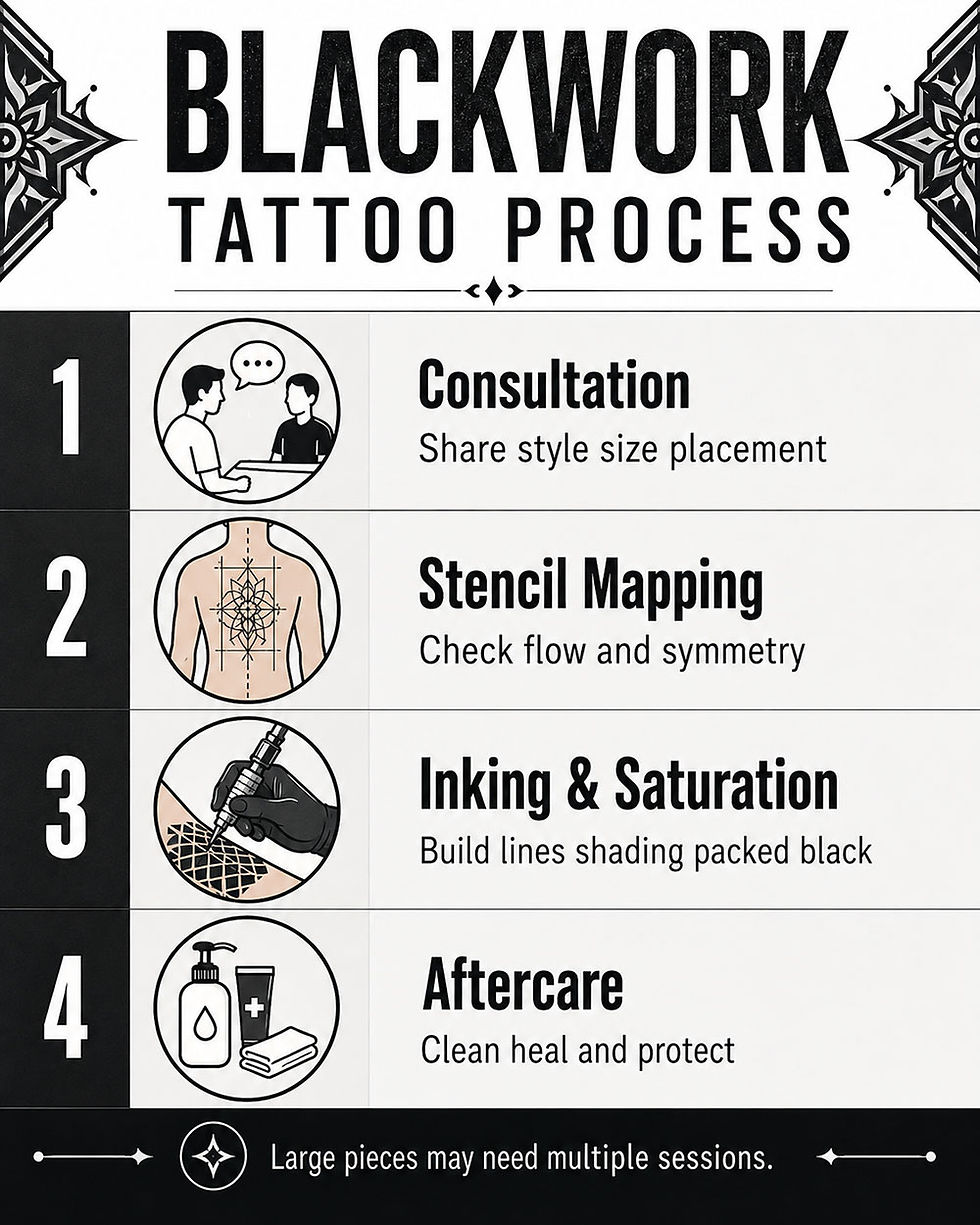
What to Expect During Your Blackwork Tattoo Session
Knowing what happens during the process can make booking a custom tattoo feel more straightforward. At Creato Tattoo Liverpool, each stage is designed to clarify the artwork, prepare the skin and support comfortable healing.
For highly detailed or large-scale blackwork, more than one session may be recommended. Your artist will explain the estimated schedule during the consultation.
Free Consultation
Your project begins with a consultation at 114 Bold Street, Liverpool L1 4HY, or through WhatsApp if you are unable to visit immediately.
You can share reference images, explain the meaning behind the tattoo and discuss the preferred size and placement. For cover-ups, clear photographs of the existing tattoo are especially helpful.
The artist will then advise whether the idea is suitable for the chosen area and whether any changes are needed to improve readability or longevity.
Custom Stencil Mapping
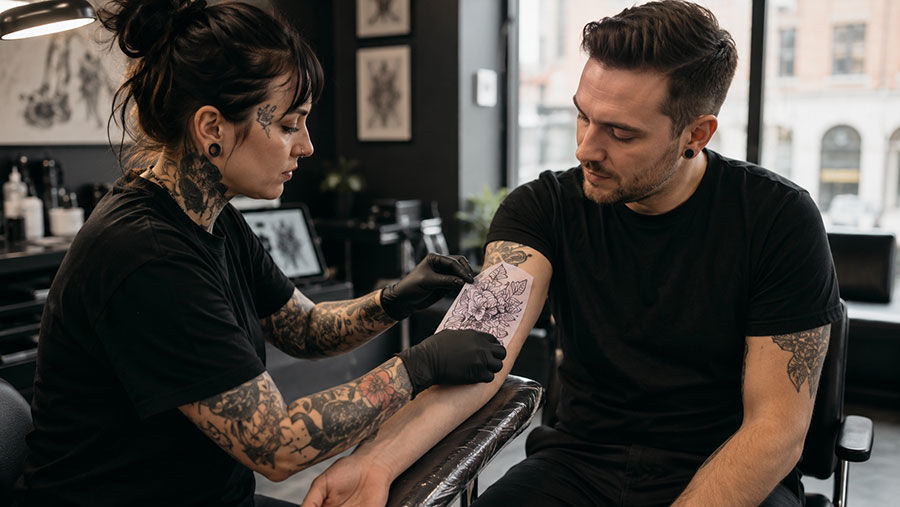
Once the design is ready, a stencil is applied to the skin. The artist checks the positioning while you are standing or sitting naturally, as the body may change shape when it moves.
For symmetrical work, the centre lines and surrounding anatomical landmarks are carefully measured. For sleeves and wrapping designs, the stencil may be adjusted several times until the flow feels natural from every angle.
You will have the opportunity to review the placement before tattooing begins.
Inking and Saturation
During the session, your artist may begin with the main lines before building shading, texture and solid black sections. The order can vary depending on the design and the condition of the skin.
Breaks can be taken when necessary, particularly during long appointments. Large areas of heavy saturation may be separated across multiple sessions to protect skin health and maintain an even finish.
Eating a proper meal, staying hydrated and avoiding alcohol before the appointment can help you feel more comfortable during the session.
Aftercare and Healing
Your new tattoo will be cleaned and protected before you leave the studio. You will receive instructions explaining when to remove the covering, how to wash the tattoo and which products to use.
Some redness, warmth and light swelling are common shortly after tattooing. As the area heals, it may begin to flake or peel. Picking the skin can remove pigment and create uneven healed areas, so the tattoo should be allowed to shed naturally.
Avoid soaking the tattoo, intense sun exposure and unnecessary friction until the skin has healed. Once healed, regular sun protection can help preserve the contrast of the black ink.
Frequently Asked Questions
Does Blackwork Tattoo Ink Fade or Turn Blue or Green?
All tattoo pigments can soften gradually as the skin ages and receives sun exposure. Older black tattoos sometimes appear blue or green because of historic pigment formulations, ink depth and long-term changes within the skin.
Modern professional black pigments are designed to heal as a neutral, deep black. Proper application, careful healing and regular use of high-SPF sun protection can help the tattoo maintain stronger contrast.
How Painful Is a Heavy Blackwork Tattoo?
Pain varies according to the placement, session length and individual tolerance. Heavy blackwork may feel more intense than a small linework tattoo because the artist must work repeatedly across a larger area to create consistent saturation.
Large projects can be divided into shorter appointments. This may make the process more manageable and gives the skin enough time to recover between sessions.
Can Blackwork Cover Scars?
Some fully healed scars can be tattooed, but suitability depends on their age, texture, colour and cause. Raised, sensitive or recently formed scars should not be tattooed until they have matured and have been appropriately assessed.
Blackwork may help visually integrate certain scars into a larger composition, but dense black ink is not automatically suitable for every scarred area. An in-person consultation is recommended before making a decision.
Ready for Your Next Blackwork Piece?
A blackwork tattoo can be subtle and ornamental, dark and illustrative or unapologetically bold. What connects every successful blackwork design is controlled contrast, clear composition and consistent technical execution.
Whether you are planning your first black tattoo, expanding an existing collection or covering an unwanted piece, Creato Tattoo can help turn your references into a bespoke design created specifically for your skin.
Visit Creato Tattoo at 114 Bold Street, Liverpool L1 4HY, or message the team on WhatsApp to begin your custom blackwork project.
Ready to transform your idea into striking black ink?


Comments