All About Geometric Tattoos

Updated: Sep 18
Geometric tattoos transform circles, lines, triangles, dots and repeating patterns into balanced, modern body art. A design may be as subtle as one fine-line symbol or as complex as a large mandala or geometric animal. Because every angle and gap affects the composition, this style demands careful planning, accurate placement and controlled execution.
Design direction | Best suited to | Visual character |
Minimal linework | Small tattoos and first-timers | Clean, subtle and modern |
Sacred geometry | Meaningful medium or large pieces | Symmetrical and layered |
Dotwork geometry | Mandalas and ornamental designs | Textured and dimensional |
Geometric animals | Personal statement pieces | Organic yet structured |
3D geometry | Bold custom artwork | Technical and eye-catching |
Creato Tattoo develops custom geometric, fine-line and dotwork pieces around each client’s idea and anatomy. Based on Bold Street in Liverpool, the studio offers consultations for people who want to refine a reference, explore symbolic shapes or plan a larger geometric project. Book online or message the studio through WhatsApp to start discussing your design.

Popular Geometric Tattoo Styles and Design Concepts
Geometric tattooing ranges from restrained symbols to dense patterns that wrap around a limb. The right direction depends on your preferred detail, meaning, placement and visibility.
Sacred Geometry and Mandalas
Sacred geometry uses repeated forms and balanced proportions to suggest order, harmony and connection. Common ideas include the Flower of Life, overlapping circles, polygonal grids and patterns built from a central point. mandala tattoo use radial symmetry, allowing lines and dots to expand outward in a controlled flow. They work best when the placement gives the centre stability and the outer details enough space.
Minimalist Line and Shape Tattoos
Minimal geometric tattoos may feature paired triangles, circles, fine polygons or intersecting lines. They suit discreet placements and understated body art. Yet simple designs are not necessarily easier to tattoo: every line and connection must look intentional, while the size must leave enough negative space to remain readable.
Dotwork and Stippled Geometry
Dotwork creates shading and texture through carefully spaced dots. Dense placement produces darker sections, while wider spacing forms softer gradients. It suits mandalas, sacred symbols and geometric sleeves because it adds depth without overpowering the structure. Creato Tattoo presents dotwork alongside fine-line and minimal tattooing.
3D and Optical Illusion Geometric Art
Three-dimensional designs use perspective, repetition and shading to create depth or movement. Cubes, impossible shapes and folding planes can appear to rise from or sink into the skin. These tattoos need sufficient space and custom stencil adjustment because body curvature can distort an illusion designed for a flat image.
Geometric Animals and Nature
Geometric animal tattoos combine recognisable subjects with structured shapes. Wolves, stags, birds and insects may be divided into polygons, framed by circles or blended with realism tattoo elements. Mountains, flowers, waves and celestial imagery can be treated similarly, turning a personal symbol into a contemporary composition.
The Hidden Meanings Behind Geometric Shapes
Geometric symbols do not have one fixed interpretation. Their meaning may come from tradition, personal experience or visual balance. Familiar associations can still provide a useful starting point for a custom design.
Geometric Shape | Primary Meanings | Design Uses & Combinations |
Circles | Wholeness, unity, continuity, and completion. Overlapping circles show relationships or life phases. | Can stand alone, form mandalas, or act as a foundation for larger patterns. |
Triangles | Stability, direction, strength, contrast, and balance (depending on orientation). | Combines naturally with mountains, arrows, and abstract linework. |
Cubes & Metatron’s Cube | Structure, logic, physical form, and order. Valued for both spiritual associations and symmetry. | Uses connected lines and circles to create multiple complex shapes within one design. |
Spirals & Fibonacci Forms | Growth, movement, natural cycles, and personal development. | Guides natural elements like shells, leaves, and flowers without looking overly mathematical. |
Circles: Wholeness and Continuity
A circle has no visible beginning or end, making it a symbol of unity, continuity and completion. It may stand alone or form the foundation of a mandala or larger pattern. Overlapping circles can represent relationships or different parts of life meeting.
Triangles: Strength and Balance
Triangles are associated with stability, direction and strength. Their orientation changes the character of a piece, while intersecting or mirrored triangles can suggest contrast and balance. They combine naturally with mountains, arrows and abstract linework.
Cubes and Metatron’s Cube: Structure and Order
Cubes can suggest structure, logic and physical form. Metatron’s Cube combines connected lines and circles to create multiple shapes within one design. Some clients value its spiritual associations; others choose it for its symmetry.
Spirals and Fibonacci-Inspired Forms: Growth
Spirals often represent movement, cycles and personal development. Fibonacci-inspired compositions draw on proportions seen in natural growth patterns. These ideas can guide shells, leaves, flowers or abstract forms without making the tattoo look like a mathematical diagram.
Why Precision Matters in Geometric Tattooing
Geometric tattooing leaves little room for inconsistency. Lines need smooth movement, circles must remain balanced and repeated gaps should appear even. A design that looks perfect on a screen can shift over muscle, bone or a joint, so the stencil should be assessed while the client stands naturally.
The artist must also adapt the concept to a realistic scale. Lines positioned too closely can lose separation, while excessive micro-detail may soften as the skin changes. Simplifying a section, opening negative space or increasing the size can protect the visual structure without sacrificing the original idea.
Getting Your Geometric Tattoo at Creato Tattoo
Creato Tattoo treats each project as a custom collaboration rather than copying a reference image exactly. The official portfolio includes dotwork, fine-line and minimal work, while owner-artist Saeid describes an inclusive practice built around individual designs, hygiene and ten years of tattooing experience. The studio is located at 114 Bold Street in Liverpool and accepts enquiries through its website and WhatsApp.
Custom Design and Consultation
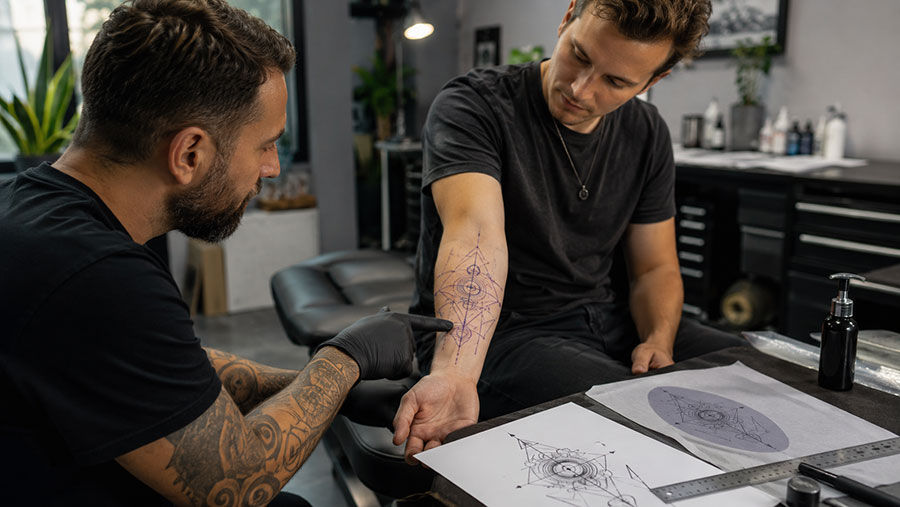
Your consultation is the time to explain what attracts you to geometric art and what you want the tattoo to express. References can show your preferred line weight, density and mood, but the final design should fit your body. Size, placement, budget and possible future extensions should be discussed before finalising it.
Body Mapping and Stencil Adjustment
The stencil must account for centre lines, muscle movement, visible landmarks and the direction from which the tattoo will usually be seen. Mandalas need a stable centre, while wrapping patterns must connect cleanly around the limb. Repositioning and checking the stencil from several angles is a valuable part of the process, not an unnecessary delay.
Fine-Line and Dotwork Execution
Fine-line tattooing requires controlled movement, consistent depth and deliberate pacing. Dotwork adds another level of concentration because spacing determines every gradient and transition. The artist may recommend making a line slightly stronger, widening a narrow gap or removing a tiny detail so the tattoo works effectively on skin and remains clear after healing.
A Hygienic and Welcoming Environment
Creato Tattoo describes its Bold Street studio as inclusive, hygienic and eco-conscious. This can be particularly reassuring for first-time clients who have questions about preparation, comfort, privacy or healing. The studio also offers online options for an in-person price estimate and a phone appointment, making it easier to discuss placement, approximate size and references before the tattoo session.
Best Placements for Geometric Tattoos
Placement determines how clearly a geometric design can be viewed. Flatter areas often suit straight lines and centred patterns, while curved areas can create movement when the artwork is designed to wrap naturally. The right location depends on the shape, scale, symmetry and desired visibility of your tattoo.
Forearm and Inner Arm
The forearm suits vertical patterns, fine-line symbols, geometric animals and elongated mandalas. Its shape provides a useful canvas for structured work and allows the design to become part of a future half or full sleeve. The inner forearm offers a more contained area for smaller or more personal pieces.
Upper Back and Chest
The upper back provides width for large mandalas and symmetrical designs organised around the spine. The chest can support central motifs or mirrored artwork following the collarbones. Both placements allow substantial detail, although the artist must account for natural differences between the two sides of the body.
Calves and Thighs
Calves work well for vertical patterns and geometric designs following the length of the lower leg. Thighs offer more room for detailed animals, optical illusions and layered sacred geometry. Both locations can accommodate a design that may later expand without forcing the original piece into a crowded layout.
Shoulders and Wrapping Patterns
The rounded shoulder can support radial designs that follow the deltoid. Geometric bands can wrap around an arm or leg, but aligning the joining points is technically demanding. The full circumference must be mapped carefully so spacing and line direction remain consistent when viewed from different angles.
Combining Geometry with Existing Tattoos
Geometric elements can sometimes connect existing tattoos or bring structure to an open area. Frames, circles, dotwork shadows, repeated patterns and negative space may complement botanical, realistic, illustrative or black-and-grey work. A new design might surround the existing tattoo, extend from it or create a deliberate transition into a larger composition.
The best approach depends on the darkness, size, placement and condition of the current tattoo. Creato Tattoo can review clear photographs or assess the area in person before recommending integration, reworking or a cover-up strategy. Some ideas may require more space or blackout tattoo coverage than expected to produce a clean result.

What to Expect During Your Session?
A geometric tattoo session usually progresses through final design approval, body mapping, stencil placement, tattooing and aftercare. Detailed or large-scale work may be divided into several appointments so that each section can be completed accurately without making one session unnecessarily long.
Design Confirmation and Placement
Before tattooing begins, the artist confirms the concept, scale and placement with you. The stencil is then applied to prepared skin and viewed while you stand naturally. Minor changes at this stage are normal, and you should feel comfortable asking to see the design from different angles before giving final approval.
Precise Lining and Dotwork
The main structure may be outlined before smaller internal patterns, dots and shading are added. Breaks can help you remain still and allow the artist to maintain concentration. The total time will depend on the tattoo’s size, density, body location and whether it is completed in one session or planned as a multi-stage project.
Personalised Aftercare
After the appointment, follow the instructions provided for your tattoo and dressing. Creato Tattoo’s published aftercare guidance emphasises gentle cleaning, careful drying, avoiding swimming during early healing and protecting the tattoo from strong sunlight once appropriate. Good aftercare supports healthy healing and clarity, but line blowout is mainly related to how ink is placed during tattooing rather than something aftercare alone can prevent.
Healing and Long-Term Clarity
A fresh geometric tattoo may temporarily appear dry, dull or slightly uneven as the surface heals. Avoid picking, scratching or soaking the area, and allow the skin to settle before judging small details. Contact the studio if you are uncertain about healing instead of applying unrelated products or following generic advice that conflicts with your artist’s instructions.
All tattoos change gradually with the skin, and very fine lines can become softer over time. Appropriate sizing, sufficient spacing, skilled application, proper healing and ongoing sun protection can help preserve definition. A touch-up may occasionally be recommended after the tattoo has fully healed.
Frequently Asked Questions
Why Are Geometric Tattoos Harder to Execute?
Their quality depends on consistency. Uneven lines, distorted circles, mismatched spacing and poor stencil alignment are particularly noticeable in a structured pattern. The artist must control the technical application while also understanding how flat geometry changes across a curved and moving body.
Can Creato Tattoo Add Geometry to My Existing Tattoo?
In many cases, geometric frames, dotwork, repeated patterns or negative space can complement existing work. The artist will need clear photographs or an in-person consultation to assess the tattoo’s darkness, condition and placement before confirming what can be achieved.
Do Fine-Line Geometric Tattoos Fade Faster?
Very delicate lines may soften sooner than bolder marks, especially when the tattoo is extremely small, frequently exposed to sunlight or placed in a high-friction area. Choosing a suitable scale and spacing is important for maintaining readability.
How Long Does a Detailed Mandala Tattoo Take?
Timing depends on size, placement, line density, dotwork and shading. A small symbol may require a relatively short appointment, while a detailed mandala, sleeve section or optical design may take several hours or multiple sessions. The consultation provides a more realistic estimate.
Create a Perfectly Balanced Geometric Tattoo
A successful geometric tattoo brings precision, movement and personal meaning together. Whether you prefer a minimal symbol, sacred geometry, a dotwork mandala or a structured animal design, the finished piece should be created for your anatomy rather than copied directly from a flat reference.
Creato Tattoo offers custom geometric, fine-line and dotwork consultations from its studio on Bold Street in Liverpool. Send your idea, placement and references through WhatsApp or book a consultation to begin developing a tattoo with thoughtful symbolism, balanced composition and clean execution. Ready for a perfectly balanced geometric piece? Book your consultation with Creato Tattoo today.


Comments